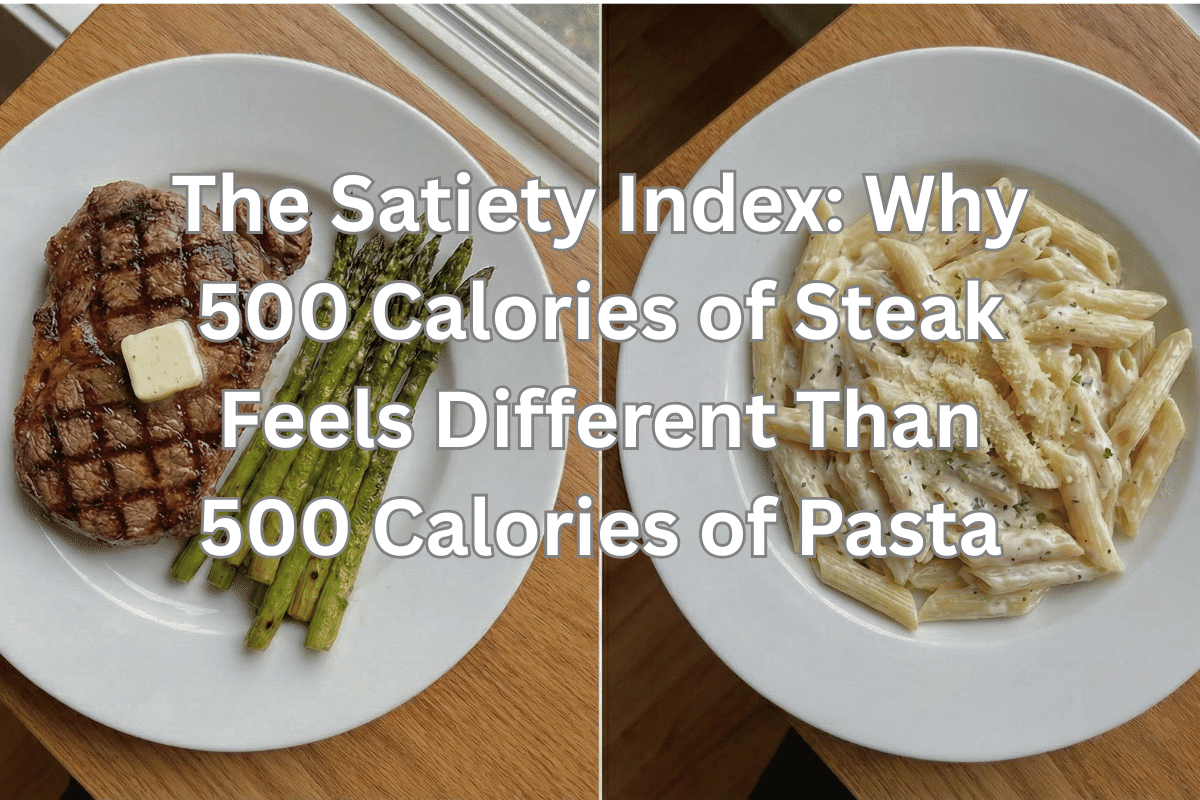
We have all been there. You finish a large bowl of pasta—perhaps even a “healthy” portion of whole-wheat noodles—and within two hours, your stomach is growling again. You feel a strange mix of being physically bloated yet biologically hungry. On the other hand, if you eat a 10-ounce steak with a side of asparagus, you might find yourself skipping the next meal entirely because you simply aren’t interested in food.
In the world of nutrition, we are often told that “a calorie is a calorie.” From a pure physics standpoint, this is true; a calorie is simply a unit of energy. But from a biological standpoint, the source of that calorie changes everything. If you are constantly asking yourself, “Why am I always hungry on a diet?” the answer isn’t that you lack willpower. The answer lies in Satiety.
Table of Contents
- What Exactly is Satiety? (The Science of Fullness)
- 500 Calories of Steak vs. 500 Calories of Pasta
- Why Protein is the King of Satiety
- The Danger of “Disappearing” Calories
- How Satiety Leads to Natural Calorie Restriction
- Practical Tips to Increase Your Satiety Today
- Final Thoughts: The Road to a Full Life
- Deep Dive Podcast: The Satiety Secret
- Related Questions
At Reluctant Low Carb Life, we focus on the Trifecta of Health: Freshness, Fitness, and Satiety. Today, we are going deep into the pillar of Satiety. Understanding the science of fullness is the “cheat code” to weight loss and long-term health. When you focus on protein and nutrient density, you stop fighting your hunger and start working with your biology.
What Exactly is Satiety? (The Science of Fullness)
Before we can fix your hunger, we have to define it. Most people confuse “fullness” with “satiety,” but they are two different stages of the eating process:
- Satiation: This is the feeling of becoming full while you are eating. It’s the signal that tells your brain to stop the current meal.
- Satiety: This is the feeling of fullness that persists after the meal is over. It is the period of time between meals when you are not thinking about food.
When we talk about the Satiety Index, we are looking at how different foods rank in their ability to keep you satisfied for longer periods. High-satiety foods keep your blood sugar stable and your hunger hormones quiet. Low-satiety foods (like pasta, white bread, and sugary snacks) trigger a “hunger loop” that forces you to eat again far sooner than you should.
500 Calories of Steak vs. 500 Calories of Pasta
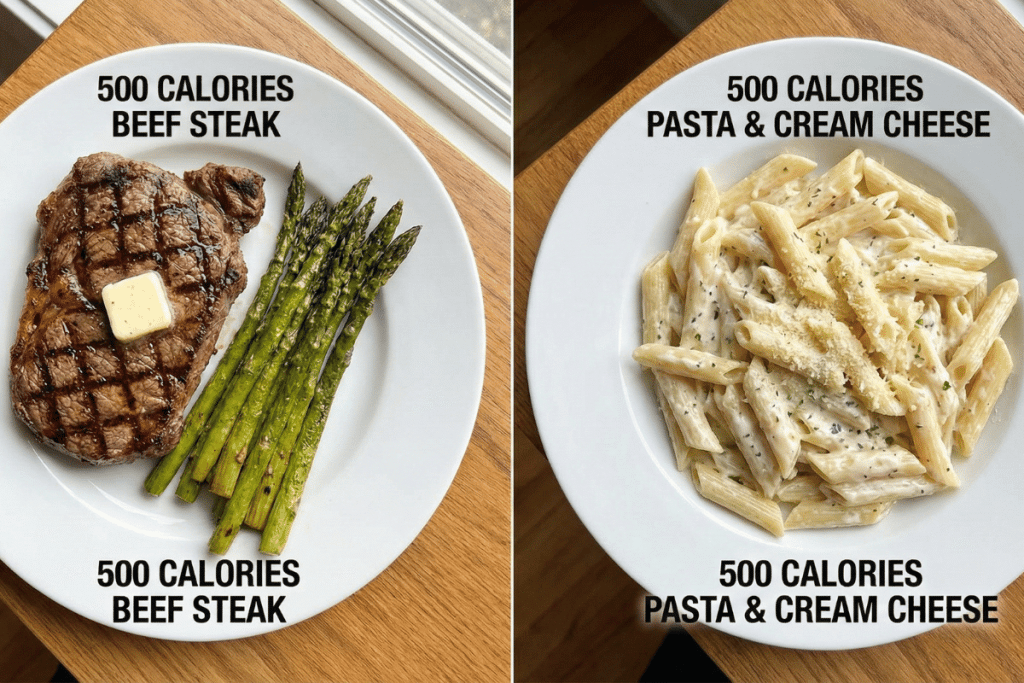
To understand why your body reacts differently to these two foods, we have to look at what happens inside your digestive system and your brain.
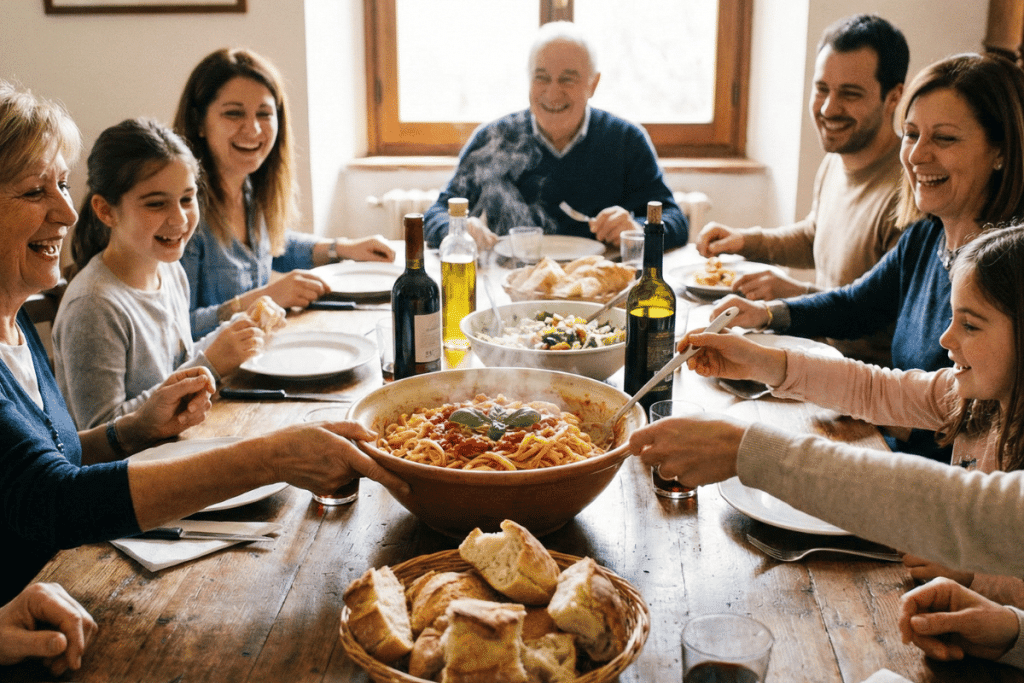
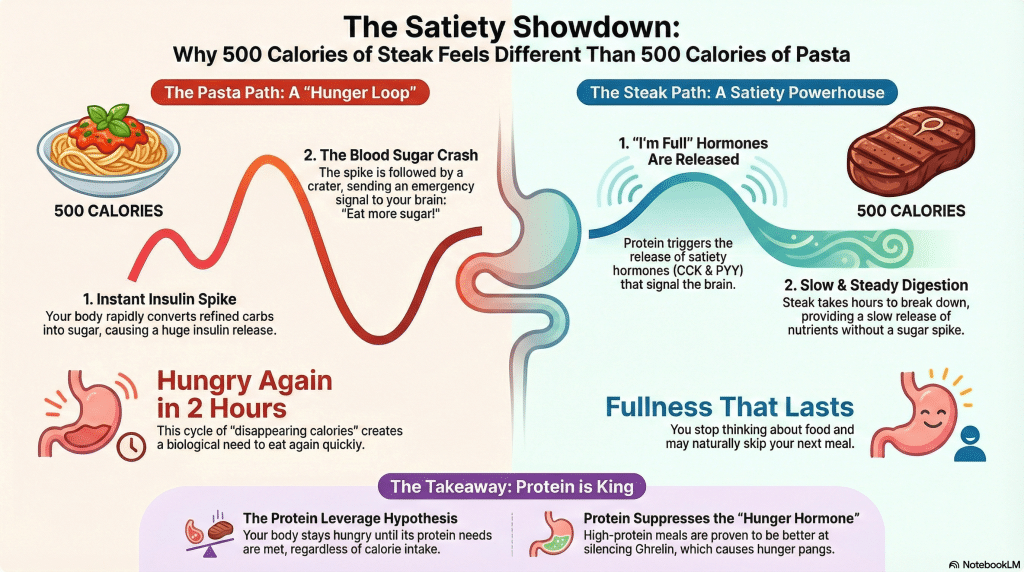
The Pasta Path: The “Disappearing” Calorie
When you eat 500 calories of pasta, you are consuming a massive hit of refined carbohydrates.
- The Insulin Spike: Your body breaks those carbs down into glucose (sugar) almost instantly. Your pancreas pumps out insulin to clear that sugar from your blood.
- The Crash: Because pasta lacks significant fiber and protein, your blood sugar spikes and then craters. When it crashes, your brain receives an emergency signal: “Energy is low! Eat more sugar now!”
- The Volume Illusion: Pasta is what we call a “dense” calorie source but a “low-satiety” one. You can eat a large volume of it without triggering the hormonal “off switch.”

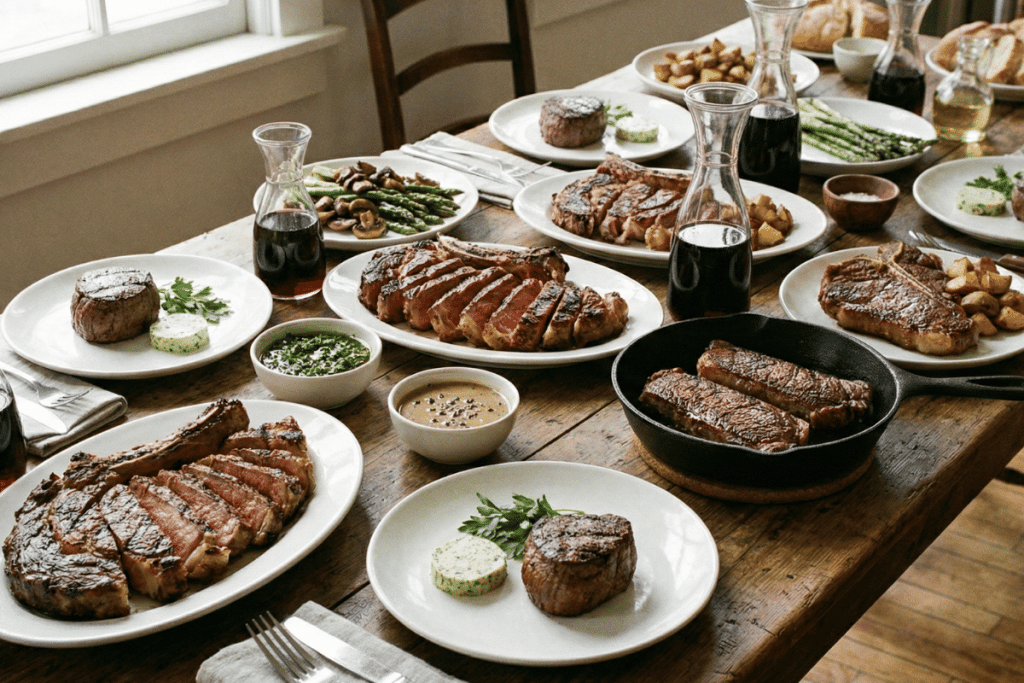
The Steak Path: The Satiety Powerhouse
Now, look at 500 calories of steak.
- The Thermic Effect: Protein has a high Thermic Effect of Food (TEF). Your body actually burns about 20–30% of the calories in protein just trying to digest it.
- Hormonal Signaling: As protein hits your gut, it triggers the release of Cholecystokinin (CCK) and Peptide YY (PYY). These are the “I am satisfied” hormones that go straight to your brain.
- Slow Digestion: Steak takes hours to break down. It sits in your stomach longer, providing a steady, slow release of nutrients rather than a volatile sugar spike.
The Result: Two hours later, the pasta eater is looking for a cookie. The steak eater hasn’t even thought about the kitchen.
Why Protein is the King of Satiety
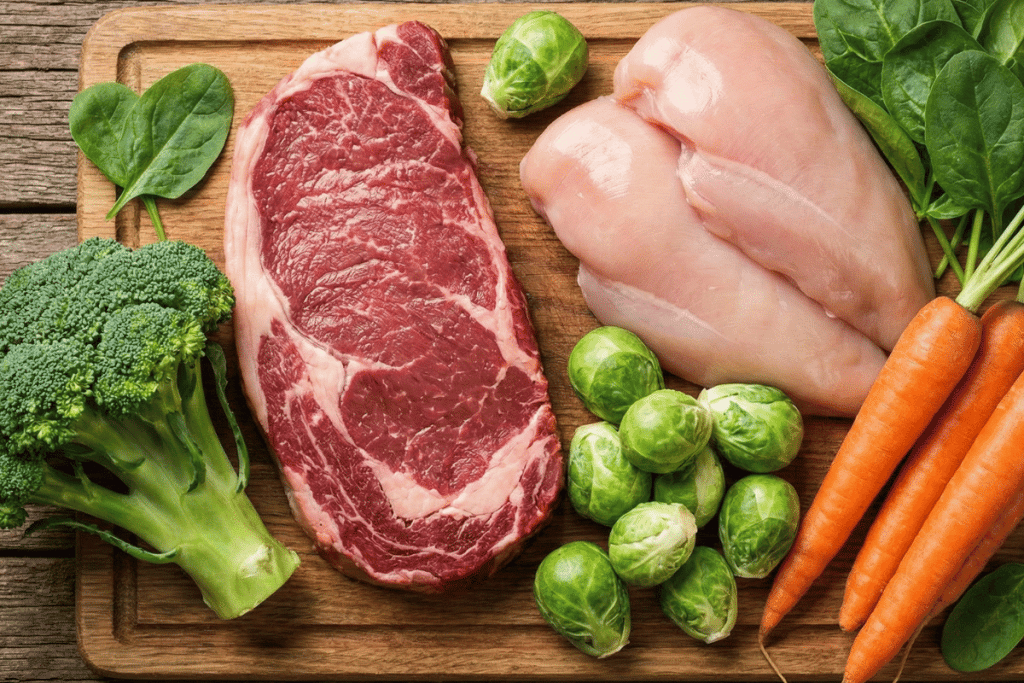
If you want to stay full longer, you must prioritize protein. It is the most satiating macronutrient by a landslide. There are three main reasons why protein helps you win the battle against hunger:
1. The Protein Leverage Hypothesis
Biologists have proposed a theory called the “Protein Leverage Hypothesis.” It suggests that humans (and many other animals) will continue to eat until they have met a specific protein requirement for the day.
If you eat a diet high in processed carbs and fats but low in protein, your body will keep “asking” for more food because it hasn’t received the amino acids it needs to repair your muscles, skin, and organs. You aren’t “hungry for calories”—you are hungry for protein. Once you hit your protein threshold, your hunger naturally shuts off.
2. Suppressing the “Hunger Hormone” (Ghrelin)
Ghrelin is the hormone that makes your stomach growl and makes you “hangry.” Studies show that high-protein meals are significantly better at suppressing ghrelin than high-carb meals. When you focus on protein, you aren’t just adding “good” food; you are actively silencing the “bad” signals that lead to overeating.
3. Muscle Maintenance and Metabolic Rate
Satiety isn’t just about the gut; it’s about the metabolic engine. Protein helps you maintain lean muscle mass. The more muscle you have, the more stable your metabolic rate. When your metabolism is stable and your body is well-nourished with protein, you don’t experience the frantic “starvation” signals that often come with low-calorie, low-protein dieting.
The Danger of “Disappearing” Calories
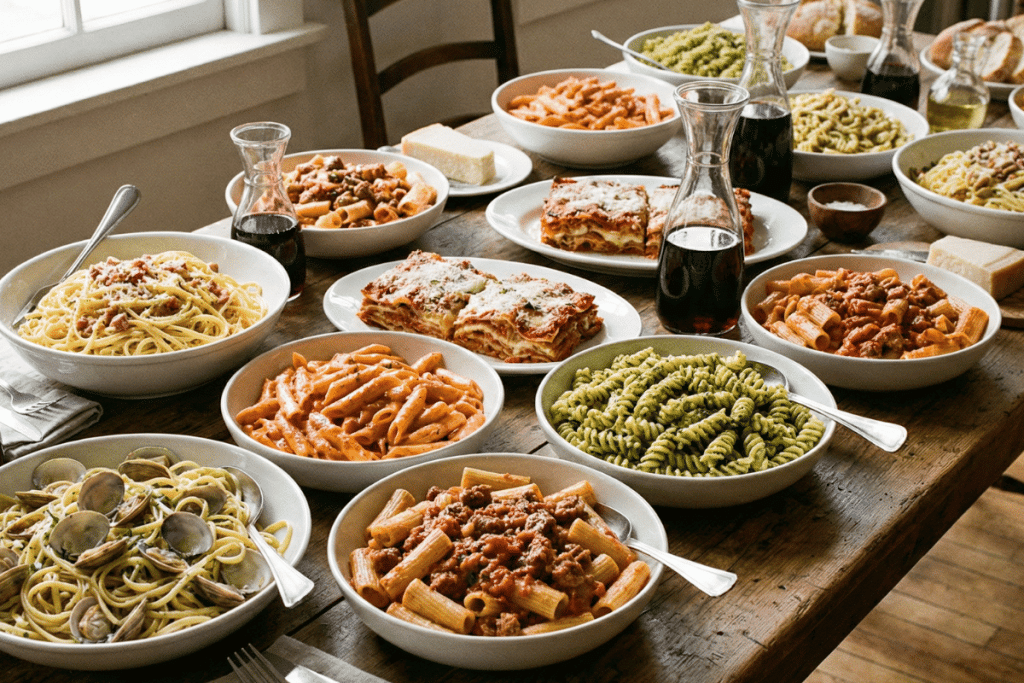
In our modern food environment, we are surrounded by what I call “disappearing calories.” These are ultra-processed foods designed to bypass your satiety signals.
Think about a bag of potato chips or a bowl of buttered pasta. These foods are “hyper-palatable”—they hit the perfect bliss point of salt, sugar, and fat. Because they lack fiber and protein, they don’t take up much room in the stomach, and they digest almost instantly. You can easily consume 1,000 calories of these foods without ever feeling “full.”
This is the primary reason why people fail on traditional diets. If you try to lose weight by eating 1,500 calories of “low-fat” processed snacks and pasta, you will be miserable. You will be in a constant state of biological hunger.
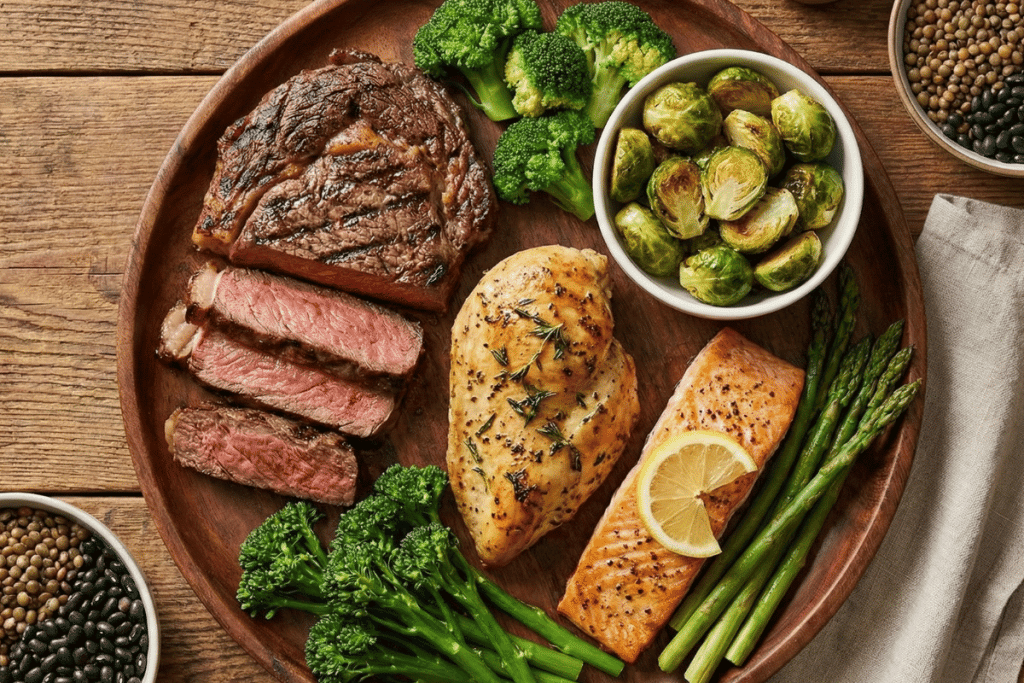
The Reluctant Low Carb solution? Eat 1,500 calories of fresh meat, eggs, and fiber-rich vegetables. You will likely find it difficult to even finish all that food.
How Satiety Leads to Natural Calorie Restriction
The most beautiful thing about the Satiety Index is that it makes “counting calories” almost unnecessary.
When you stay full longer, you naturally do not eat as much as you normally would. This is called spontaneous calorie reduction. * You don’t need a “snack” at 3:00 PM because your lunch was protein-heavy.
- You don’t need a “late-night treat” because your dinner provided lasting satiety.
- Your portions naturally get smaller because your brain’s “off switch” is actually working.
Instead of fighting your body with math and willpower, you are nourishing your body so that it chooses to eat less. This is the only sustainable way to live a low-carb life.
Practical Tips to Increase Your Satiety Today
If you want to put the Trifecta of Health into practice, start with these simple shifts to your plate:
- Eat Your Protein First: Don’t save the steak for the end. Eat the protein and fiber-rich vegetables first. By the time you get to any side dishes, your satiety hormones will already be signaling your brain that you are full.
- Choose Whole over Processed: A whole orange has more satiety than orange juice. A steak has more satiety than a protein shake. The more “intact” the food is, the harder your body has to work to digest it, and the longer you will stay full.
- Prioritize “Fresh over Everything”: Fresh foods naturally contain more water and fiber. This adds volume to your stomach without adding excessive calories. This physical “stretch” in the stomach sends a signal to the brain to stop eating.
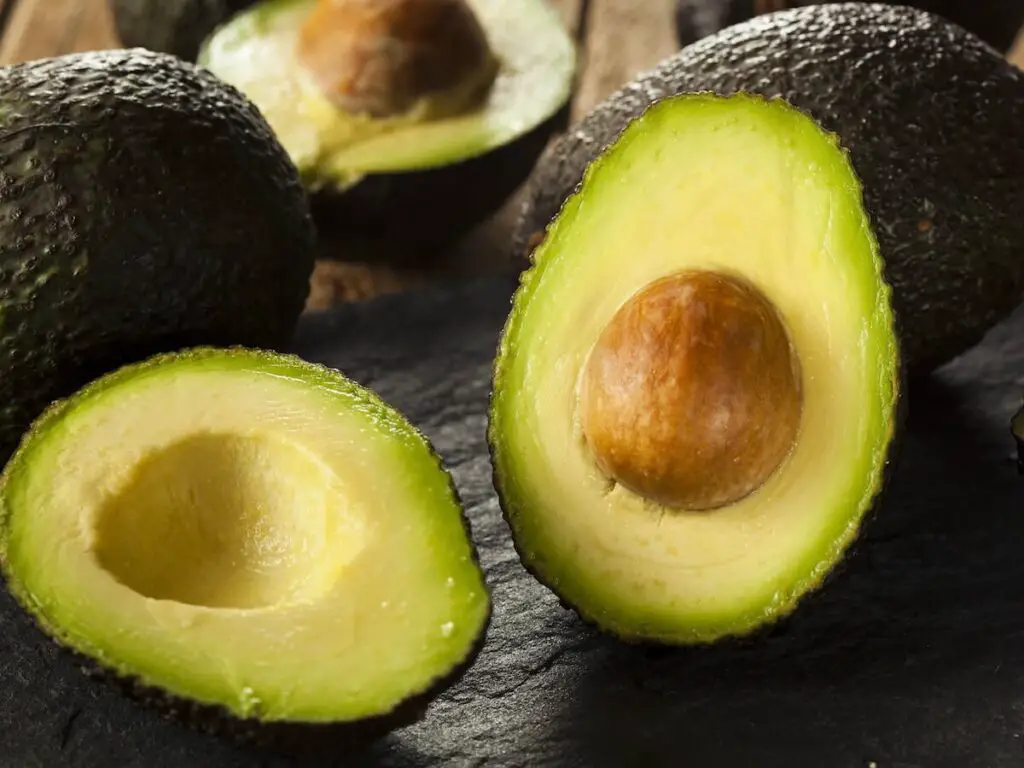
- Embrace Healthy Fats for “Long-Tail” Satiety: While protein is the king of immediate fullness, healthy fats (like those found in salmon, avocado, or grass-fed butter) provide the “long-tail” satiety that keeps you going for 4–5 hours between meals.
Final Thoughts: The Road to a Full Life
We named this blog The Reluctant Low Carb Life because we know that changing your diet is hard. We know that people don’t want to feel deprived. The good news is that when you focus on the Satiety Index, deprivation disappears.
You aren’t “dieting”—you are optimizing. By choosing 500 calories of nutrient-dense protein over 500 calories of empty starch, you are giving your body the tools it needs to thrive. You’ll have more energy for your Fitness routine, you’ll enjoy the Freshness of real food, and most importantly, you will finally feel Full.
Stop being a victim of your hunger. Focus on protein, embrace satiety, and watch how easily the rest of the Trifecta falls into place.
Deep Dive Podcast: The Satiety Secret
Want to hear more about the science of hunger? Listen to our latest episode where we break down the “Protein Leverage Hypothesis” and share our favorite high-satiety recipes!
What is the one food that always keeps you full?
At Reluctant Low-Carb Life, we applaud this change and hope that it will inspire more people to take control of their health through mindful eating and a focus on nutrient-dense, satisfying foods. While there is no one-size-fits-all approach to nutrition, the principles outlined in the new food pyramid provide a solid foundation for creating a healthier, more balanced diet.
As we move forward, let’s continue to advocate for real food, celebrate the joy of cooking and eating fresh, wholesome meals, and support one another on our journeys to better health. Together, we can create a healthier future for ourselves and for generations to come.
What are your thoughts on the new food pyramid? Do you agree with the changes, or do you have concerns about certain recommendations? Share your thoughts in the comments below—we’d love to hear from you!
Reluctant Low Carb Life explores all aspects of keto and low-carb lifestyle, fitness, health, wellness, and aging gracefully. At the Reluctant Low Carb Life, we strive to give honest and accurate information to people trying to live the low-carb and keto lifestyle while improving their fitness and health.
We have a free monthly newsletter that is filled with information and helps you remain updated. Subscribe to the Reluctant Low Carb Life newsletter by clicking here.
Listen to our weekly podcast, Reluctant Low Carb Life or Deep Dive By Reluctant Low Carb Life, on all the major podcast platforms by clicking here.
Follow us on Instagram and Facebook by clicking here.
Related Questions
20 Reasons Why Swimming Is A Great Sport
We love swimming because it provides a low-impact, full-body workout that engages almost all your muscles while improving cardiovascular fitness and mental well-being. Swimming helps with weight management, enhances flexibility and posture, boosts breathing efficiency, and promotes relaxation. It’s a versatile activity suitable for all ages and fitness levels, making it easy to incorporate into your fitness regimen.
You can read more about 20 Reasons Why Swimming Is A Great Sport by clicking here.
Using MySwimPro App to Help Improve Your Swimming
Swimming, in its essence, can be a rather monotonous sport. You dive in, swim back and forth, and repeat. Without any form of stimulation or structure, it’s easy for the sport to become dull and unengaging. I’ve tried to make my swimming sessions more enjoyable by using headsets like the Ex Trainer, allowing me to listen to music or podcasts while I swim. This game-changer has made my time in the water much more pleasant. However, for those who don’t have access to headsets, swimming can quickly turn into a repetitive routine of laps.
You can read more about Using MySwimPro App to Help Improve Your Swimming by clicking here.
Swimming Vs. Walking For Weight Loss
If you’re trying to lose weight and enjoy swimming and walking, you may want to know what is better for weight loss. Both exercises can help you get fit and down to your optimal weight.
Most people will burn more calories by swimming than by walking. But whether swimming or walking is better for weight loss comes down to which exercise you will do consistently and which exercise you enjoy. People will tend to stick to an exercise they want more than one they do not like.
You can read more about Swimming Vs. Walking For Weight Loss by clicking here.



Leave a Reply
You must be logged in to post a comment.