Let’s be honest with each other. If you’re reading a blog called “Reluctant Low Carb Life,” you probably aren’t waking up at 4:30 a.m. bursting with excitement to crush a kale smoothie and run ten miles. You want to be healthy, you want to manage your weight, and you want to feel better, but you also want to live a real life. You want a way of eating that doesn’t feel like a part-time job or a punishment for enjoying food.
I get it. I am right there with you. We often feel like we’re spinning our wheels. We try really hard for two weeks, see minimal results, get exhausted, and order a pizza. Then the guilt sets in, and we start the cycle over. We are constantly toggling between “all-in” and “completely off the wagon.”
Table of Contents
- The Triple E Approach: Balancing Effort and Ease for Optimal Results
- The Sweet Spot: Maximum Sustainable Health
- Deep Dive Podcast
- Related Questions
The Triple E Approach: Balancing Effort and Ease for Optimal Results
The problem isn’t necessarily a lack of willpower. The problem is that we are often directing our energy in the wrong ways, or we are trying to sustain an unsustainable pace. We are missing a framework for making health actually fit into our lives long-term.
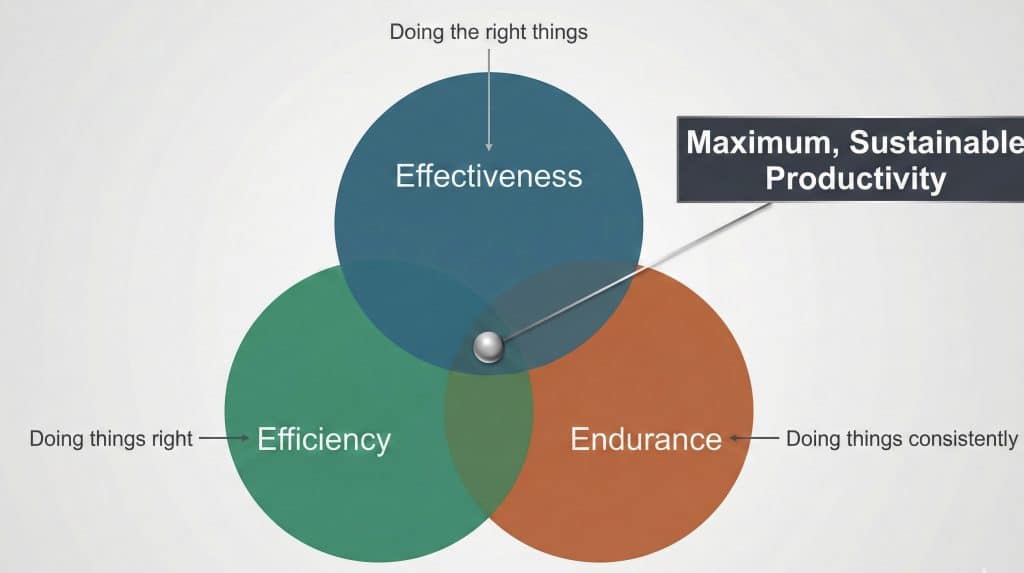
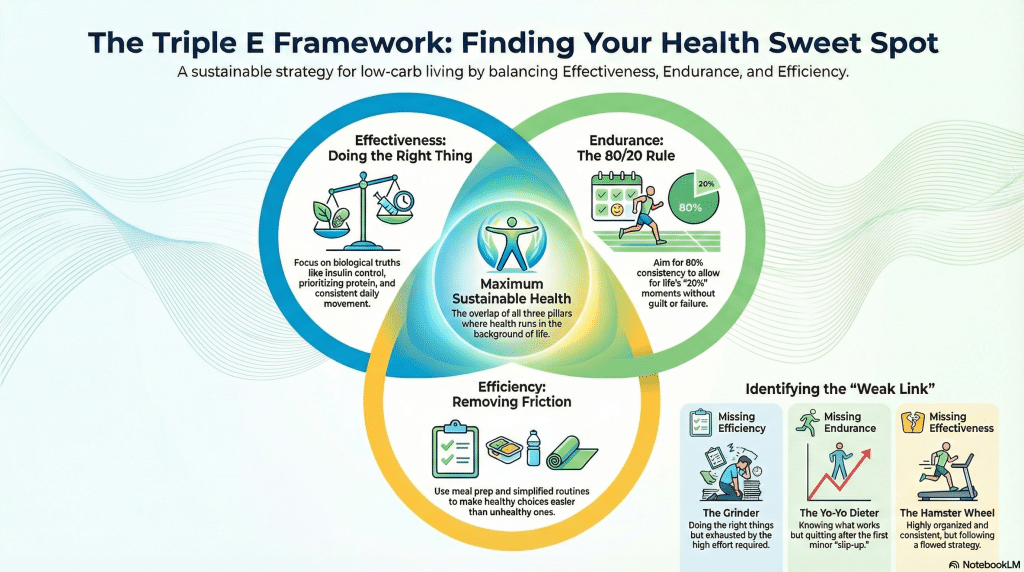
In the world of business and productivity, there’s a concept about finding the “sweet spot” for performance. It involves three overlapping circles: Effectiveness, Endurance, and Efficiency. Where they overlap in the center is called “Maximum Sustainable Productivity.”
When I first heard this, I realized: This is exactly what’s missing from most diet advice.
We need to stop treating our health like a frantic sprint and start treating it like a sustainable business model. We need to apply the “Triple E” framework to our reluctant low-carb lives.
Here is how these three pillars work together to help you finally find success without losing your mind.

Pillar 1: Effectiveness (Doing the Right Thing)
Effectiveness is the foundation. In business, it means working on the tasks that actually move the needle and generate revenue. In health and weight loss, Effectiveness simply means: Are you doing the things that actually work?
This seems obvious, but think about how much time we waste on ineffective health trends. We buy expensive supplements that do nothing. We try gadgets that promise six-pack abs in five minutes a day. We stress over whether our almond milk is organic while ignoring the three donuts we ate for breakfast.
Being effective means cutting through the noise and focusing on the fundamental biological truths of health.
For us in the low-carb world, “doing the right thing” is relatively simple, even if it’s not always easy. It means:
- Controlling Insulin: We know that keeping carbs low reduces insulin spikes, which allows our bodies to access stored fat for fuel. That is effective.
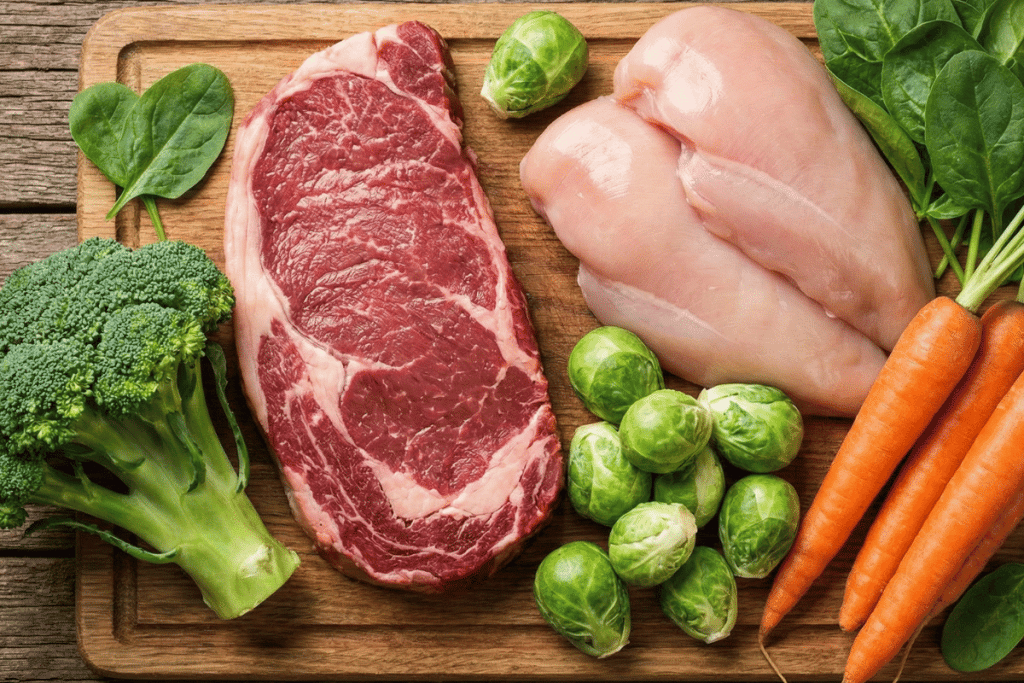
- Prioritizing Protein and Healthy Fats: Eating real, nutrient-dense food that keeps us satiated so we aren’t constantly battling hunger. That is effective.
- Moving Your Body: Not necessarily training for a triathlon, but consistent daily movement—walking, lifting heavy things occasionally, staying mobile. That is effective.
If you are spending three hours a day researching obscure superfoods but you are still drinking sugary sodas, you are being highly ineffective. You are working hard, but on the wrong things.
Effectiveness is about clarity. It’s looking at your plate and asking, “Is this moving me toward my goal or away from it?” It’s about knowing the basics of low-carb eating and sticking to them, rather than getting distracted by the latest “miracle” cure on TikTok.
If you don’t have effectiveness, nothing else matters. You can do the wrong thing very efficiently and very consistently for years, and you will only end up further away from where you want to be.

Pillar 2: Endurance (The Long Haul and the 80/20 Rule)
This is where most of us “reluctant” folks crash and burn. We might know what to do (Effectiveness), but we try to do it with 100% perfection from day one.
That is not endurance. That is a recipe for burnout.
Endurance isn’t about white-knuckling your way through life, resisting every temptation with jaw-clenching intensity. Endurance is about building a lifestyle that you can sustain not just for thirty days, but for thirty years.
Endurance is about consistency, not intensity.
If Effectiveness is “doing the right thing,” Endurance is “doing the right thing most of the time.”
Enter the 80/20 Rule.
This is the golden rule for the reluctant low-carber. The 80/20 rule (or the Pareto Principle) suggests that 80% of your results come from 20% of your efforts. But in diet terms, we flip it slightly to mean this: If you are on point with your eating and movement 80% of the time, you can afford to relax for the other 20% and still make incredible progress.
This is game-changing for mindset.
If you eat 21 meals a week, 80% consistency means about 17 of those meals are “on-plan” low carb. That leaves roughly four meals a week where life happens. Maybe it’s a birthday cake at a party. Maybe it’s pizza night with the kids. Maybe it’s just a Tuesday where you were exhausted and caved into a craving.
Under the old “perfectionist” model, that one slip-up meant you were a failure, so you might as well binge for the rest of the week.
Under the Endurance model using the 80/20 rule, that slip-up is just… part of the 20%. It’s accounted for. You haven’t failed. You just had a moment. The next meal is another chance to step back into the 80%.
Endurance understands that we are human beings with emotions, social lives, and stress. We will have downtime. We will get sick. We will go on vacation. A plan that requires 100% adherence breaks the moment real life intrudes. A plan built for endurance bends without breaking.
True endurance is the ability to get back on track quickly without drama or self-loathing. It’s understanding that the long haul is won by average consistency, not sporadic bursts of perfection.
Pillar 3: Efficiency ( Doing the Thing Right)
If Effectiveness is what you do, and Endurance is how long you do it, Efficiency is how you do it.
Efficiency is about lowering the barrier to entry. It’s about making the “right things” (low carb, exercise) easier to do than not to do. It’s getting maximum results for minimum unnecessary effort.
I don’t know about you, but I am busy. I am often tired. If eating healthy requires me to spend two hours in the kitchen every night chopping twenty different vegetables, I’m not going to do it. That is ineffective because it’s unsustainable.
Efficiency is the reluctant low-carber’s best friend. It’s the “hack” that makes the lifestyle stick.
What does efficiency look like in health?
- Meal Prep: No, not spending your entire Sunday cooking. But maybe spending one hour roasting a bunch of chicken thighs and chopping some veggies so that Tuesday night’s dinner takes ten minutes to assemble instead of an hour to cook. That’s efficient.
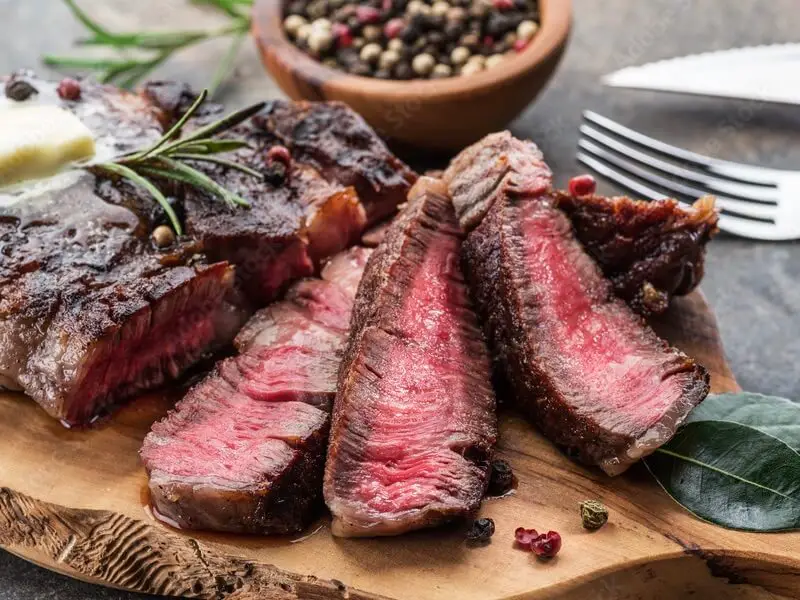
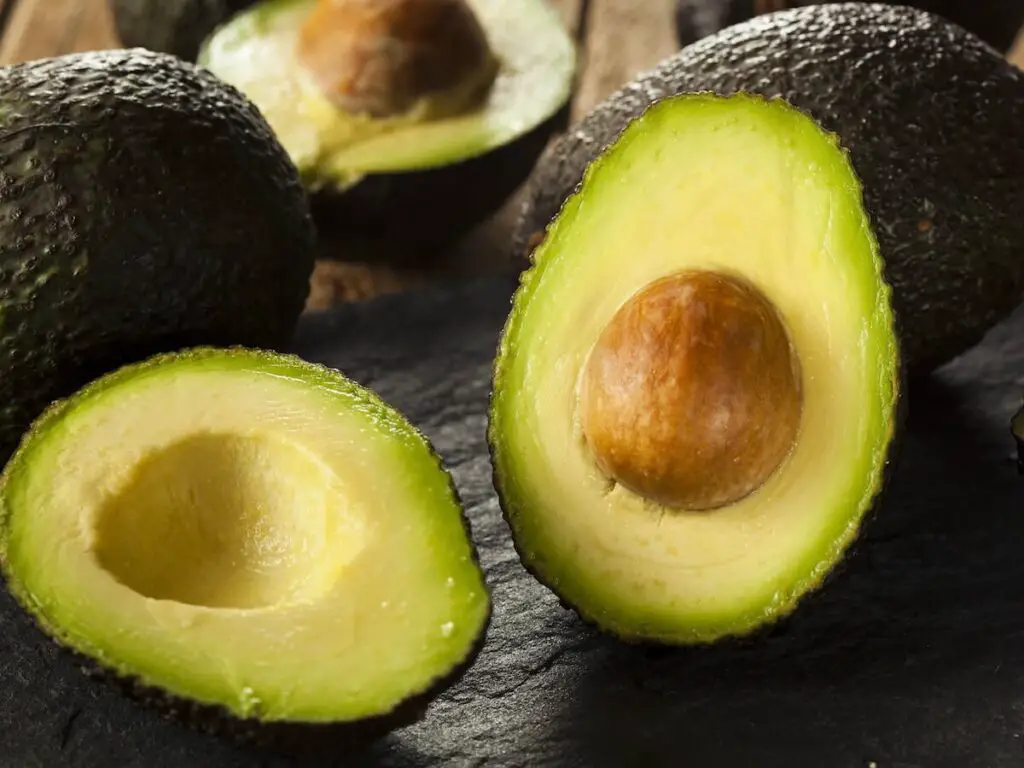
- Simplifying Meals: Realizing that a dinner of scrambled eggs, avocado, and some leftover steak is perfectly acceptable and highly nutritious. You don’t need a gourmet keto recipe every night. “Boring” is often highly efficient.
- Knowing Your Go-Tos: Having a mental list of three fast-food places where you know exactly what to order to stay low-carb when you’re stuck in traffic and starving. That prevents panic-ordering fries.
- Smarter Exercise: Instead of trudging on a treadmill for an hour (inefficient and boring), maybe you do a 20-minute intense resistance training session that stimulates more muscle growth in less time.
Efficiency is about removing friction. If you have to fight yourself every step of the way to do the right thing, you will eventually run out of willpower. Efficiency builds systems so you don’t need willpower.
If you are effective and have endurance, but you lack efficiency, your health routine will feel like a constant, draining slog. It will take up too much of your mental RAM. We want health to run in the background of our lives, not take center stage.

The Sweet Spot: Maximum Sustainable Health
Now, visualize those three circles overlapping.
- Effectiveness: You know you need to keep carbs low and move your body.
- Endurance: You accept that you only need to do this 80% of the time to succeed long-term.
- Efficiency: You have found simple, quick ways to make those low-carb meals happen.
Where those three overlap in the center is the holy grail. It’s Maximum Sustainable Health.
When you hit this sweet spot, amazing things begin to happen. The struggle starts to dissipate. You stop feeling like you are constantly “on a diet” and start feeling like this is just “how you eat.”
Let’s look at what happens when you are missing one piece of the puzzle:
Missing Efficiency (The Grinder): You are doing the right things (low carb), and you are doing them consistently (endurance), but it takes so much effort. You are always cooking, always cleaning, always stressed about food prep. You will eventually burn out because it’s just too hard to maintain.
Missing Endurance (The Yo-Yo Dieter): You know what works (effectiveness), and when you do it, you have good systems (efficiency). But you expect perfection. You go hard for three weeks, lose ten pounds, have one bad weekend, declare yourself a failure, and gain twelve pounds back over the next two months. You lack the long-term view.
Missing Effectiveness (The Hamster Wheel): You are very consistent (endurance) and very organized (efficiency) at doing the wrong things. Maybe you are consistently eating “low fat” processed “health foods” full of sugar. You are working incredibly hard, showing up every day, but seeing zero results because your fundamental strategy is flawed. This is the most frustrating place to be.
Finding Your Center
For us reluctant low-carbers, this framework is liberation.
It gives us permission to stop trying to be perfect Instagram health warriors. It tells us that it’s okay to find the easiest way to get the job done.
Start asking yourself where your weak link is right now.
Are you confused about what to eat? Focus on Effectiveness. Get back to basics: meat, vegetables, healthy fats.
Are you burning out every few weeks and quitting? Focus on Endurance. Implement the 80/20 rule immediately. Give yourself grace for the slip-ups and just focus on the next meal.
Does it feel like healthy living takes too much time and energy? Focus on Efficiency. Find one way to simplify your breakfast this week. Find one go-to takeout order that fits your plan.
We don’t have to love every minute of this journey. We can be reluctant. But by being smart about Effectiveness, Endurance, and Efficiency, we can stop fighting ourselves and finally settle into a healthy life that actually lasts.
Deep Dive Podcast
Check out our Deep Dive Podcast.
At Reluctant Low Carb Life, we are staunch advocates of the Health Trifecta: Fullness, Fitness, and Freshness. Additionally, we embrace the pillars of health, wellness, and graceful aging. Our mission is to provide honest and precise information to individuals dedicated to adopting a healthy lifestyle while enhancing their fitness and well-being.
We have a free monthly newsletter that is filled with information and helps you remain updated. Subscribe to the Reluctant Low Carb Life newsletter by clicking here.
Listen to our weekly podcast, Reluctant Low Carb Life and Deep Dive By Reluctant Low Carb Life, on all the major podcast platforms by clicking here.
Follow us on Instagram and Facebook by clicking those Social Media.
Related Questions
Ultra-Processed Food Examples: What Is Ultra-Processed Foods?
Lately, there has been a lot written about the dangers of Western nations, including the United States, overeating ultra-processed foods and the effect this food can have on our health.
But the definition of Ultra-processed foods can even seem a bit fuzzy as there are so many definitions out there. We like to look at Ultra-processed foods as foods that use ingredients you are not familiar with or ingredients you would not find in your kitchen to cook with. Read on as we try to decode and explore more about what ultra-processed foods are.
You can read more about Ultra-Processed Food Examples: What Is Ultra-Processed Foods? by clicking here.
Ultra Processed Foods – Why Chicken Nuggets Are Not Food
There’s no harm in occasionally indulging, but it’s crucial to recognize that these nuggets are a form of ultra-processed food. The issue arises when chicken nuggets become a regular part of our diet or when we mistakenly assume they’re simply chunks of chicken and nothing more. Join me as we delve into why chicken nuggets are classified as ultra-processed foods and what ingredients they contain.
You can read more about Ultra Processed Foods – Why Chicken Nuggets Are Not Food by clicking here.
Ultra-Processed Foods Health Risks Explored
When you buy an egg from the supermarket, it generally makes a straightforward journey from the farm to your kitchen table. The same goes for fresh produce like apples or oranges.
However, many packaged foods undergo a far more complex process before they end up in your shopping cart. These are often what we term ‘ultra-processed foods.’ One way to identify them is by looking at the ingredient list. If it contains items you wouldn’t typically find in your kitchen pantry or appears chemically engineered, chances are you’re dealing with an ultra-processed product. Read on as we delve deeper into the world of ultra-processed foods and explore their potential risks to your health.
You can read more about Ultra-Processed Foods Health Risks Explored by clicking here.



Leave a Reply
You must be logged in to post a comment.